MCP
What is MCP? A Simple Guide to How AI Connects to Live Cricket Data
Apr. 16, 2026
AI assistants can write, summarize, and explain things remarkably well. But when you ask for a live cricket score or a player's current season stats, they don't have a way to check. They respond based on training data that could be months old.
The answer sounds right, but the facts may not be.
MCP was built to solve exactly this.
If you want to understand MCP in detail, Anthropic (the company behind Claude AI) published a full explanation here: Introducing the Model Context Protocol.
What is MCP?
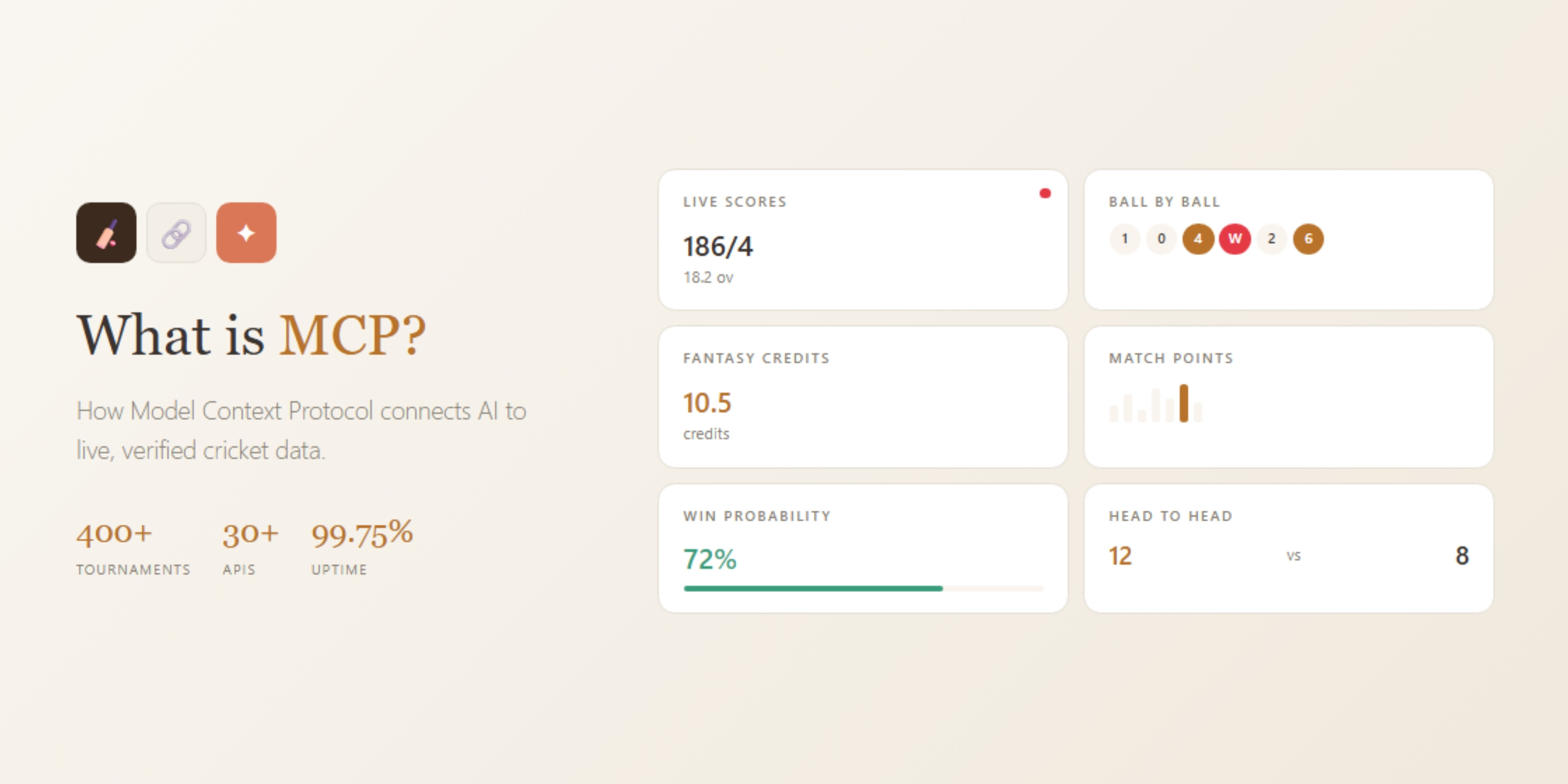
MCP stands for Model Context Protocol. It is an open standard that allows AI assistants to connect directly to live, external data sources before they generate a response.
In simple terms, MCP is a bridge. On one side, you have data (an API, a database, a live feed). On the other side, you have an AI assistant (Claude, ChatGPT, or any custom tool). MCP is the standard that connects the two, so the AI can look something up instead of making it up.
Why does this matter?
Without MCP, every AI integration requires custom code. If you want ChatGPT to access your cricket database, you build a custom plugin. If you want Claude to access the same database, you build another integration. If you want VS Code Copilot to access it, that's a third one.
MCP standardizes this. You build one MCP server for your data, and any AI tool that supports MCP can connect to it. One server, every AI platform.
How MCP works (the short version)
The flow has four parts:
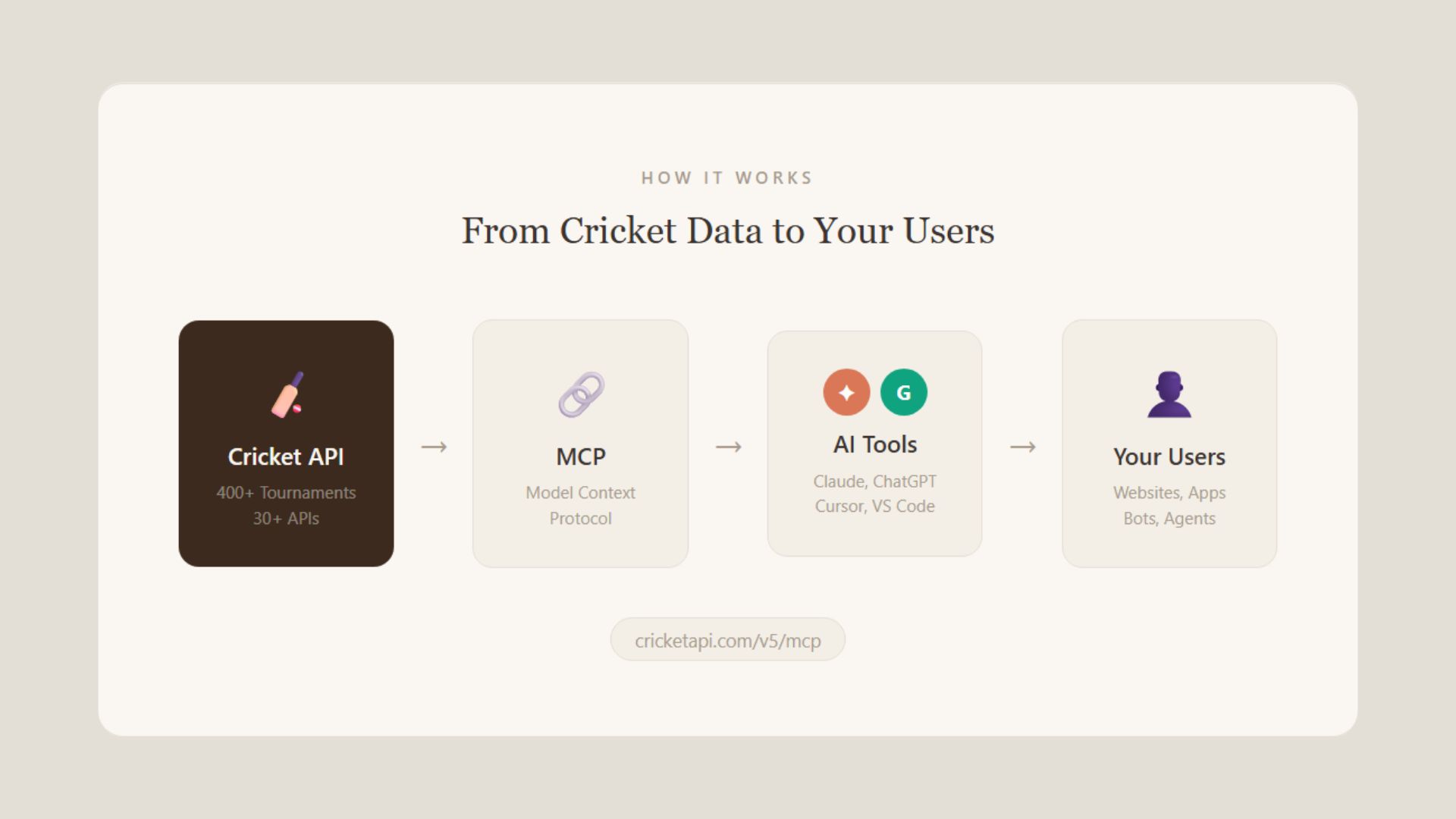
- Data source. Your API, database, or service that holds the information.
- MCP server. A layer that wraps your data source and makes it accessible through the MCP standard.
- AI assistant. Claude, ChatGPT, Cursor, VS Code, or any tool that supports MCP. It connects to the MCP server and queries it when a user asks a question.
- User. Gets an answer based on real, verified data instead of AI assumptions.
The AI assistant doesn't need to know how your API works internally. It just knows how to talk to MCP. And MCP knows how to talk to your data.
We've been providing cricket data through Roanuz Cricket API since 2012. Our data covers 400+ tournaments worldwide, with 30+ API endpoints, 99.75% uptime, and sub 300ms response times. Over 90% of fantasy cricket apps in the market today run on our data.
We built a Cricket API server for MCP so that any AI assistant can now access this same data, live, before it responds.
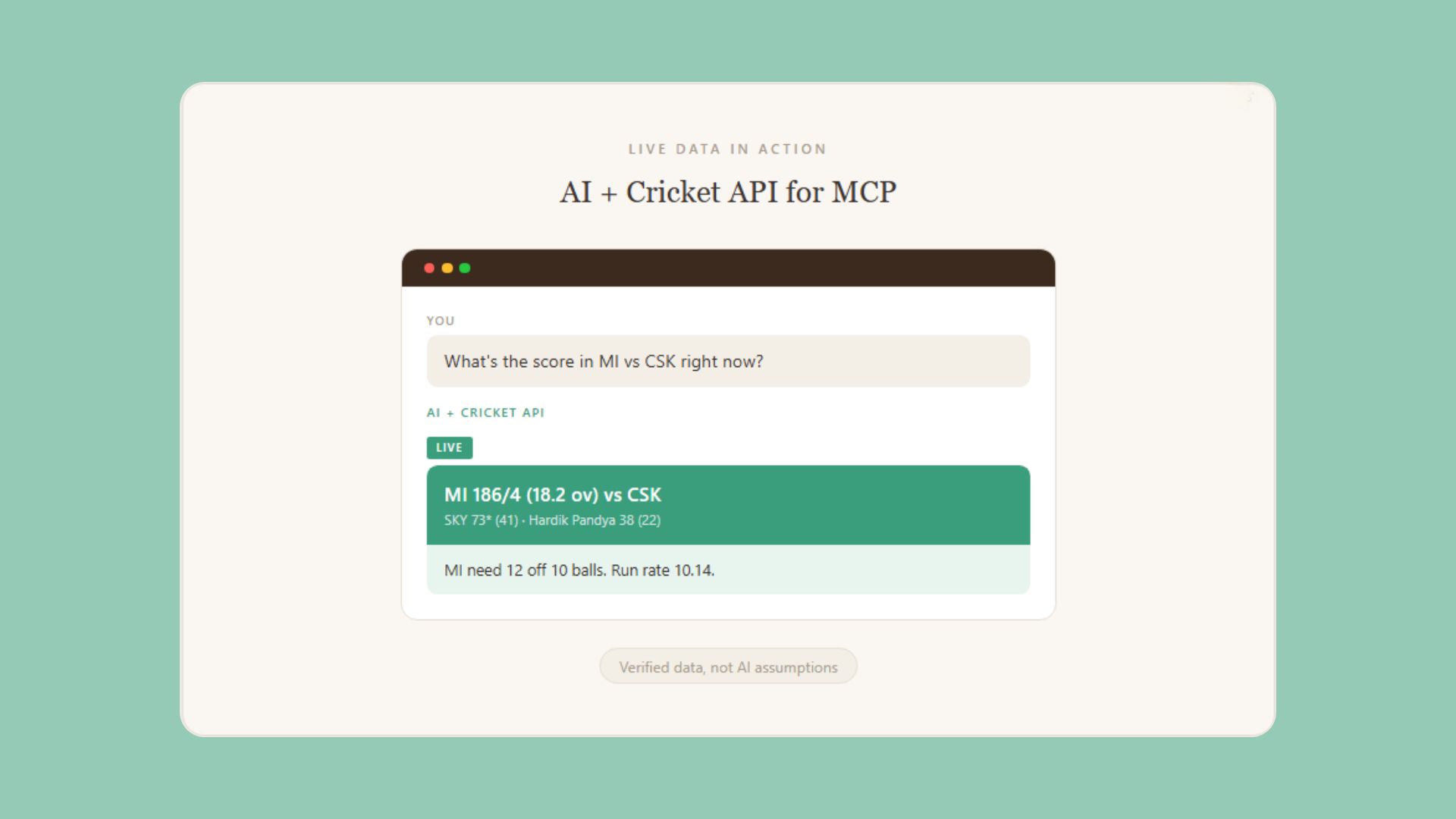 When an AI tool is connected to Cricket API through MCP, it doesn't guess a score. It checks. It doesn't invent a stat. It looks it up. The data is real, verified, and delivered in real time.
- Live scores - Ball by ball updates during every match
- Scorecards - Full batting and bowling scorecards
- Player statistics - Career stats, season stats, format specific stats
- Match points - Real time fantasy points based on match events
- Head to head records - Team vs team and player vs team comparisons
- Tournament standings - Live points tables and group standings
- Fixtures and squads - Upcoming matches and confirmed team lineups
- Historical data - Stats going back years across all formats
- Win probability - AI powered match odds and winning percentages
Tournaments covered
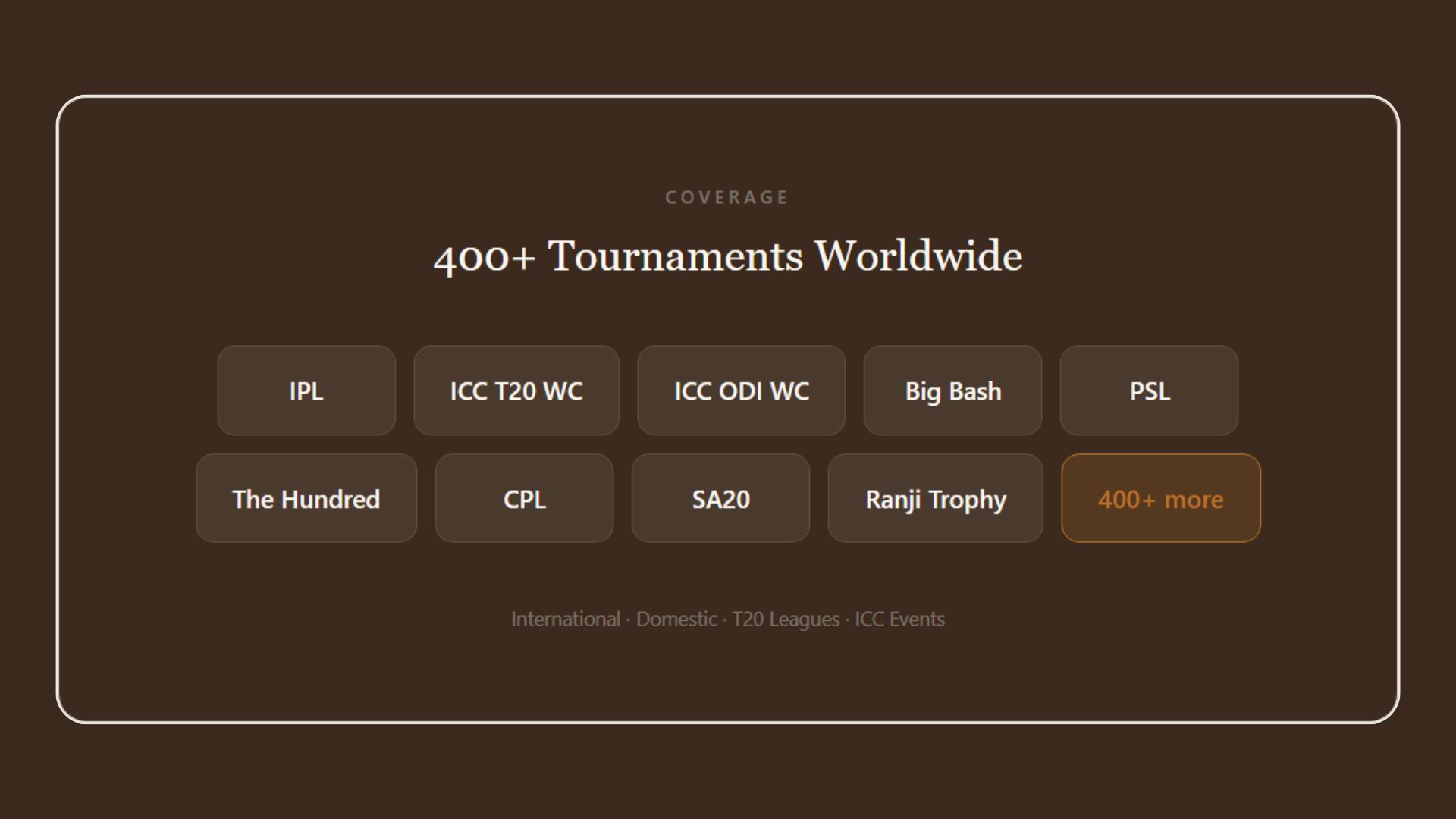
Coverage spans every format, from international ICC events to domestic leagues across the world. Every tournament listed under the Roanuz Cricket API coverage is accessible through MCP.
 MCP opens up a category of products that weren't practical before. Here are three real use cases.
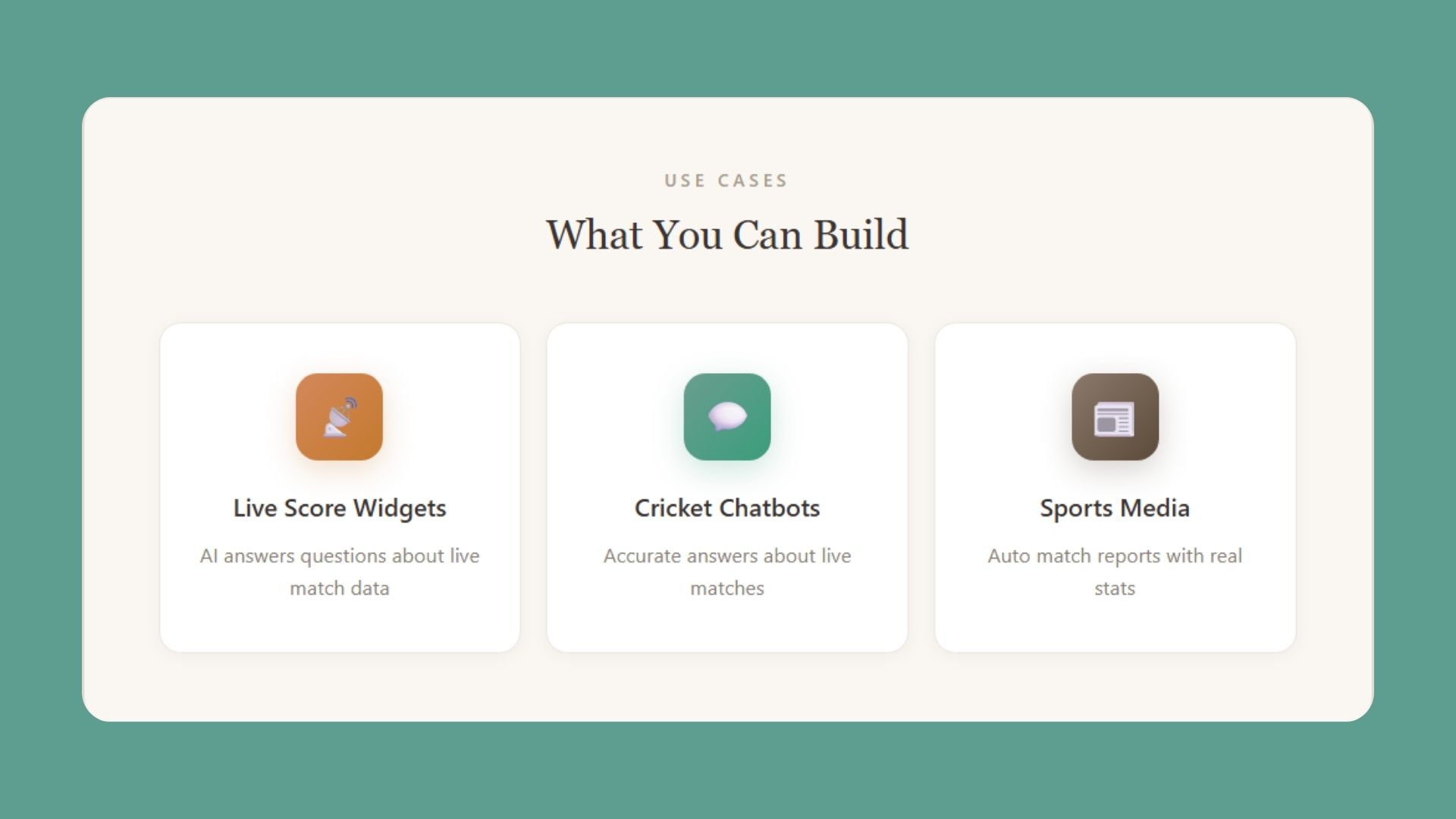 Traditional live score widgets pull data and display it in a fixed format. With MCP, you can build widgets that respond to natural language.
A user types "What's happening in the MI match?" and the widget responds with the current score, the batsmen at crease, the required run rate, and recent overs. All formatted dynamically by the AI, all sourced from real time live score data.
The difference: the widget isn't just showing data. It's answering questions about the data.
Traditional live score widgets pull data and display it in a fixed format. With MCP, you can build widgets that respond to natural language.
A user types "What's happening in the MI match?" and the widget responds with the current score, the batsmen at crease, the required run rate, and recent overs. All formatted dynamically by the AI, all sourced from real time live score data.
The difference: the widget isn't just showing data. It's answering questions about the data.
2. Cricket chatbots that give accurate answers
The biggest problem with cricket chatbots today is trust. A user asks "How did Bumrah bowl today?" and the bot either doesn't know or fabricates an answer.
With MCP, the chatbot checks Cricket API for Bumrah's actual bowling figures before responding. The user gets real numbers: overs bowled, wickets taken, economy rate. Not a guess. Not a hallucination.
This is the difference between a chatbot people try once and a chatbot people rely on.
3. Automated match reports for newsrooms
Sports media moves fast. During a tournament like the IPL, there are matches almost every day. Newsrooms need match summaries, post match analysis, and key stat highlights turned around quickly.
AI writing tools connected to Cricket API through MCP can generate match reports where every score, every partnership figure, every bowling analysis comes from a verified source. The AI writes the narrative. Cricket API provides the facts.
Cricket API for MCP works with any AI platform that supports the Model Context Protocol:
- Claude (Anthropic)
- ChatGPT (OpenAI)
- Cursor (AI code editor)
- VS Code (with Copilot or MCP extensions)
- OpenAI Agents SDK
- Any custom AI tool that implements the MCP standard
Connect by pointing your AI tool to the Cricket API MCP endpoint. No custom integration needed.
How to get started
Visit the Cricket API for MCP page to see the documentation, available endpoints, and how to connect your AI tool.
If you want to talk through a specific use case or see a demo, you can book a call with our team.
Summary
MCP connects AI to live data. Cricket API for MCP makes that work for cricket, across 400+ tournaments, with any AI tool that supports the standard.
Whether you're building a live score widget, a cricket chatbot, a media tool, or any AI product that touches cricket, this changes what's possible.
Explore Cricket API for MCP →
Book a call with our team →